
Type B or Type C circuit breaker: which one should you use?
Updated: 2026-10-26
For 230/400 V installations to IEC standards (Europe, UK and most of the world). North America uses different voltages, colours and rules: see the “Around the world” notes.
What the letter means
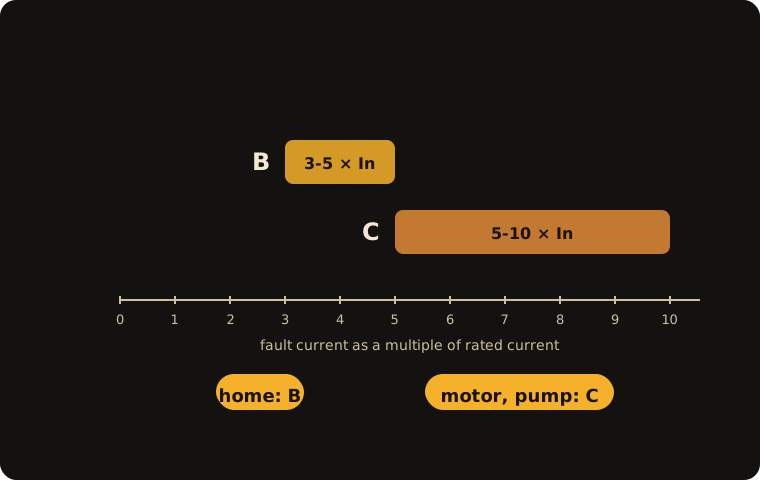
A miniature circuit breaker (MCB) has two trips. The thermal trip handles overload and works the same for B, C and D. The magnetic trip handles short circuits, and the letter tells you at what multiple of rated current (In) it acts instantly (IEC 60898-1):
| Curve | Instant trip at | Typical use |
|---|---|---|
| B | 3 to 5 × In | sockets, lighting, general domestic circuits |
| C | 5 to 10 × In | motors, pumps, large power supplies, workshops, long LED runs |
| D | 10 to 20 × In | transformers, very high inrush; rare in homes |
On overload, a breaker does not trip at 1.13 × In for at least an hour, and trips within an hour at 1.45 × In. That is why a slightly overloaded circuit can run for minutes before the breaker drops.
Why homes use B
At the far end of a long domestic circuit the short circuit current can be fairly low. A Type C breaker might not reach its instant trip fast enough there. Type B gets there more reliably, which is why it is the safer default.
When C makes sense
- B trips the moment you switch something on: many LED fittings, a big power supply, an air conditioner, a pump. That is inrush current, not a fault. A C breaker on that specific circuit is the usual answer.
- Motor circuits such as a circulation pump, compressor or gate motor.
• UK and Europe: the same B, C and D curves (BS EN 60898 / IEC 60898).
• USA: breakers follow UL 489 and are not sold by B/C letter; trip characteristics are given by the manufacturer's curves instead.
Did this answer help?