
Does swapping L and N reverse a single-phase motor?
Updated: 2026-10-26
For 230/400 V installations to IEC standards (Europe, UK and most of the world). North America uses different voltages, colours and rules: see the “Around the world” notes.
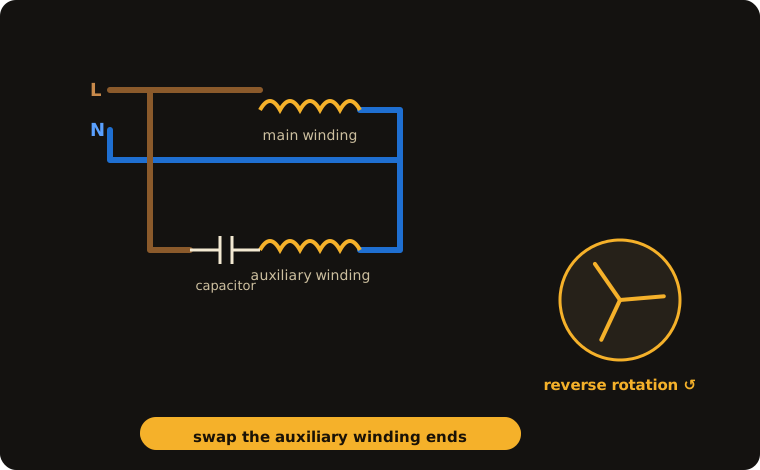
Why swapping L and N does nothing
A motor, like any ordinary load, does not "know" which wire is line and which is neutral. It simply sees an alternating voltage between two points. Swap them and it is still the same voltage, on the same windings, in the same arrangement. The rotating field that decides the direction does not change at all.
Where the myth comes from
It is a mix-up with three-phase motors. There, swapping any two of the three phases (for example L1 with L2) changes the phase sequence, which reverses the rotating field and the motor. That rule is real, it just belongs to a different kind of motor. See forward-reverse control.
How a single-phase motor is really reversed
A typical single-phase induction motor with a capacitor has two windings: the main (run) winding and the auxiliary (start) winding, shifted in phase by the capacitor. That phase shift sets the direction. To reverse it, you swap the ends of the auxiliary winding relative to the main winding (or use the motor's reversing switch, if it has one), not L and N on the supply.
Not every single-phase motor can be reversed electrically. Shaded-pole motors, common in small fans, have their direction fixed by construction. Always check the rating plate or the wiring diagram of your motor rather than a generic recipe.
Did this answer help?