
Electrical wire colours: which conductor is which?
Updated: 2026-10-26
For 230/400 V installations to IEC standards (Europe, UK and most of the world). North America uses different voltages, colours and rules: see the “Around the world” notes.
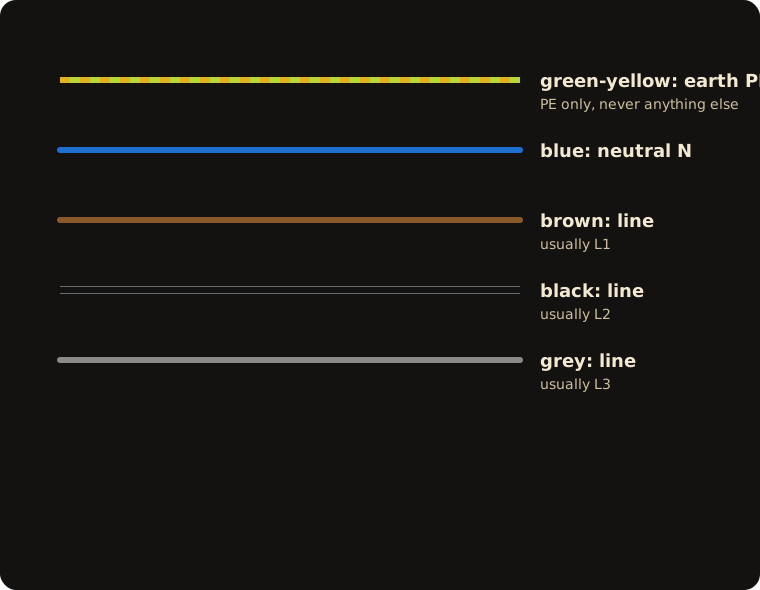
The current colours
green-yellow, always and only PE
blue
brown, the usual single-phase line
black, second phase or switched line
grey, third phase in three-phase
These colours come from the harmonised European standard (IEC 60445, HD 308). The rule that matters most: green-yellow is reserved for the protective conductor. Never use it as a line, a neutral or a switch wire, not even temporarily and not even with a marker sleeve.
Why colour alone is not enough
Many homes still have wiring from before the harmonised colours. Depending on the country and the decade, black was sometimes a neutral and red was a line. After years of repairs you can also find old and new cables mixed in one box.
- Colour is the first hint, never proof.
- Before work, identify the live core with a voltage tester, then switch off, lock off and prove dead.
- When you must use a cable without suitable colours, mark the ends with sleeves that show the function.
Does L1 have to be brown, L2 black and L3 grey?
The standard reserves brown, black and grey for line conductors, but it does not force a specific colour onto a specific phase. Brown L1, black L2, grey L3 is the common convention. What really counts is consistency within one installation. For three-phase motors, where phase order decides the direction of rotation, the sequence is always confirmed with a phase rotation tester, not by colour.
• UK: the same colours since 2004 (brown live, blue neutral, green-yellow earth). Older UK wiring uses red live and black neutral.
• USA and Canada: a different system (NEC): line conductors are usually black or red, neutral is white or grey, ground is green or bare copper. A grey wire means opposite things in Europe and the US.
• Everywhere: the protective conductor is green-yellow (IEC) or green (US). It is never a current-carrying wire in normal use.
Did this answer help?