
Impulse relay: control a light from many places with push buttons
Updated: 2026-10-26
For 230/400 V installations to IEC standards (Europe, UK and most of the world). North America uses different voltages, colours and rules: see the “Around the world” notes.
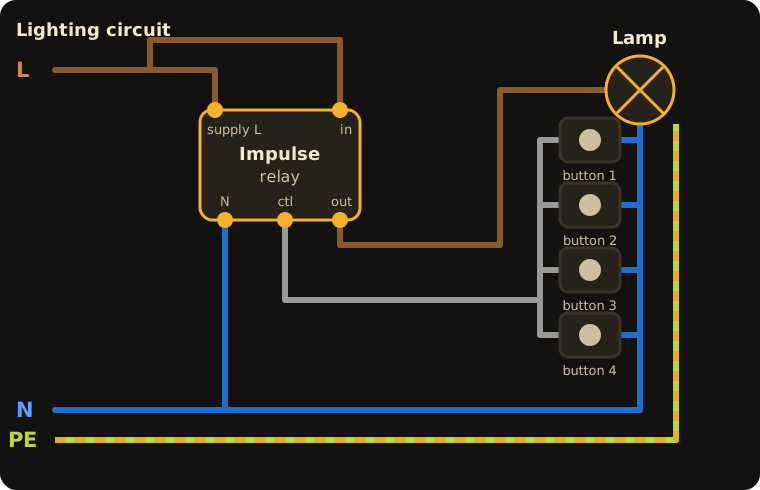
An impulse relay (latching or bistable relay) toggles a light on or off with a short pulse from any ordinary push button and then holds that state by itself. All buttons are simply wired in parallel to the relay in the distribution board, so you avoid strapper and intermediate wiring. Ideal for three or more switching points.
How it differs from two-way and intermediate switching
With two-way or intermediate switching, every extra point means more cores and special switches. With three or more points that becomes a thick bundle of cable.
An impulse relay works differently. It sits in the distribution board, fed from the lighting circuit, and every switching point is an ordinary, cheap push button (retractive, like a doorbell button) wired to the relay's control input. Each short press toggles the relay output, no matter which button sent it.
Note: with a 230 V coil, the push buttons carry full mains voltage. Cable and accessories must be rated like any other 230 V wiring. Check the coil voltage in the data sheet.
When it pays off
- Control from three, four or more places: long corridors, stairwells, garages with several doors.
- Strapper wiring was not planned before plastering, and you need another switching point.
- You want to add a button later without rewiring: just run a two-core control cable in parallel to the existing ones.
What to check
- The diagram is generic: control terminals and their polarity (for example buttons between N and the control terminal) must be checked in the manual of your relay.
- The relay has a current rating and sometimes limits on lamp type (LED drivers have high inrush): check the data sheet.
- It sits between classic wiring and a full smart home: on and off from many places, no dimming or scenes.
Around the world: in English it goes by impulse relay, latching relay, bistable relay or step relay; in German Stromstoßschalter. Whatever the name, the wiring idea is the same: buttons in parallel, one relay toggling the light.
Important: choosing the relay for the lighting load is the installer's job, and work in a distribution board must be done by a qualified person.
Did this answer help?