
Intermediate switch wiring: control a light from three or more places
Updated: 2026-10-26
For 230/400 V installations to IEC standards (Europe, UK and most of the world). North America uses different voltages, colours and rules: see the “Around the world” notes.
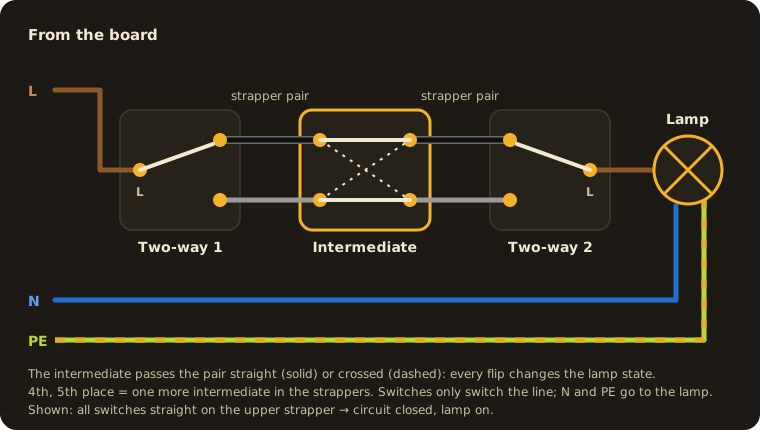
To control one light from three or more places, put two-way switches at both ends and intermediate switches in between. An intermediate switch has four terminals and either passes the strapper pair straight through or crosses it over. Every extra switching point is simply one more intermediate switch in the strappers.
The principle
- End points: two-way switches, exactly as in two-way switching.
- Middle points: intermediate switches. In one position each passes the strappers straight, in the other crossed.
- The line enters the first two-way switch and leaves the last one to the lamp. N and PE go straight to the light.
Cabling
| Section | Working cores |
|---|---|
| Two-way ↔ intermediate | 2 (strapper pair) |
| Intermediate ↔ intermediate | 2 |
| Intermediate ↔ two-way | 2 |
Each pair of switches needs two strapper cores in line colours (for example black and grey). Never use the blue or green-yellow core as a strapper: see two-way switching.
Common mistakes
- Intermediate wired like a two-way (using two terminals instead of four): the light only works in some combinations.
- Input and output pairs swapped on the intermediate: one switch seems to do nothing.
- Large circuits with many switches are hard to fault-find. From four points upwards, consider an impulse relay.
Around the world:
• UK: intermediate switch; terminals often marked L1, L2 on each side.
• USA: the same device is a 4-way switch, used between two 3-way switches.
• Germany: Kreuzschaltung.
• UK: intermediate switch; terminals often marked L1, L2 on each side.
• USA: the same device is a 4-way switch, used between two 3-way switches.
• Germany: Kreuzschaltung.
Tip: during a renovation, when you do not want to chase new cable routes, wireless push buttons with a receiver in the box or the light fitting can replace intermediate switching.
Did this answer help?