
Two-gang switch wiring: two lights from one place
Updated: 2026-10-26
For 230/400 V installations to IEC standards (Europe, UK and most of the world). North America uses different voltages, colours and rules: see the “Around the world” notes.
The rule: you only switch the line
A two-gang switch is essentially two ordinary switches in one plate, fed from one line. Each rocker connects the line to its own output:
| Terminal | What goes there |
|---|---|
| L | incoming line (supply) |
| 1 | switched line to the first light |
| 2 or 3 (depends on maker) | switched line to the second light |
Neutral (blue) and earth (green-yellow) do not enter the switch. Join them in the box and take them straight to the fittings. Check the terminal markings on your specific switch.
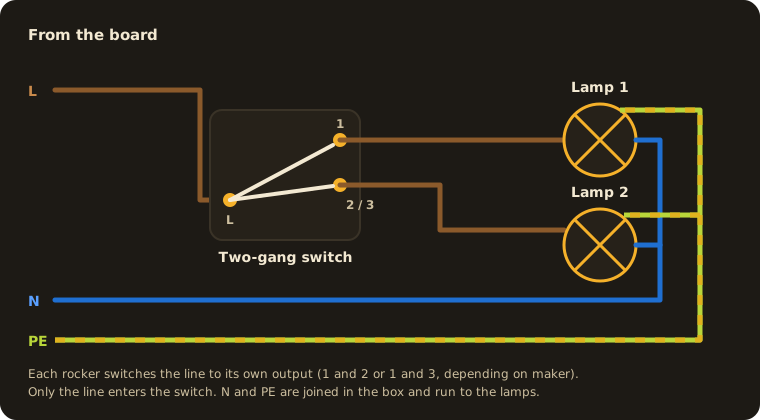
Two separate lights (for example main light and wall lights)
The supply (L, N, PE) comes into the box, and a three-core cable (switched line, N, PE) runs to each light. In the box:
- all PE together,
- all N together,
- supply line → switch terminal L,
- line core to light 1 → terminal 1, to light 2 → the second output.
Chandelier with two circuits
If both rockers control one chandelier (for example half the bulbs or all of them), the cable from switch to fitting needs two line cores, N and PE, so four cores. Inside the fitting each line feeds its own group of lamps.
Common mistakes
- Neutral switched instead of line: the lamp goes off, but the fitting stays live.
- Outputs swapped: the rockers work "crosswise" (harmless, but fix it).
- Not enough cores to the chandelier: with three cores you only get one circuit.
Did this answer help?